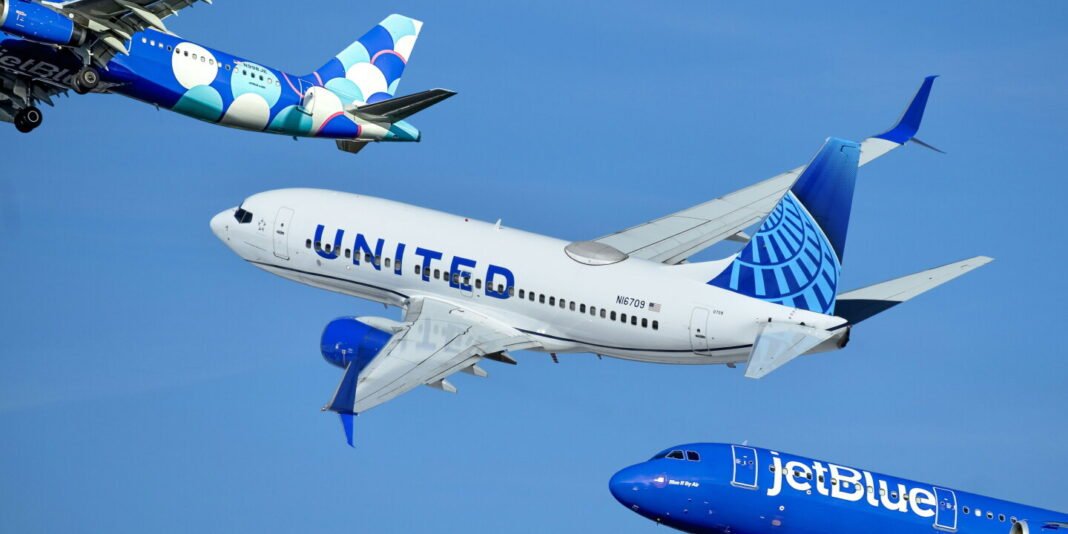


Frequent United Airlines and JetBlue flyers can now receive reciprocal benefits from both airlines, after the US-based airlines recently announced that they have expanded their partnership into a loyalty program.
Currently, eligible members of United’s MileagePlus and JetBlue’s True Blue loyalty programs enjoy elite benefits on both airlines, including same-day standby, priority boarding, and free baggage.
For passengers, the announcement marks the most impactful aspect of the companies’ Blue Sky collaboration, which began last May. Since then, passengers have been able to not only earn and redeem miles with both airlines, but also book flights on both networks through interline agreements.
“Reciprocal elite benefits are great for each airline’s status members and make it more comfortable and cost-effective to fly on other airlines, making customers more likely to do so,” Gary Leff, founder of airline site View from the Wing, told Afar.
Here’s what else travelers should know:
Priority boarding, same-day standby, and other common benefits
Since May, JetBlue passengers have had access to United’s international flights to 350 destinations on six continents, and United passengers now have additional flight options to JetBlue’s leisure destinations in the Caribbean and Latin America.
However, under the partnership’s newly announced reciprocal benefits, these flights will come with additional loyalty benefits across both airlines, including priority check-in at participating airports, priority security lines and same-day standby options.
Also, for the first time in a MileagePlus partnership, members can choose preferred seating in seats with extra legroom, such as United’s Economy Plus and JetBlue’s Even More seats. (Some systems may require members to book first and then go back and add seat selections.) They also receive one free checked bag with priority baggage processing on each airline.
Finally, members also have access to early boarding, depending on their eligibility and status. United’s Premier Platinum and 1K members on JetBlue flights have priority boarding in Group 1, Premier Gold members in Group 2, and Premier Silver members in Group 3. Meanwhile, JetBlue Mosaic 2, 3 and 4 members can fly United in Group 1, while Mosaic 1 can join Group 2. (To receive these reciprocal benefits, eligible members must include their frequent flyer number when booking.)
“This next step will give our customers even more of the benefits they already know and value when traveling on either airline’s network,” said Jarrad Fisher, president of United’s MileagePlus program. “Loyalty must feel tangible to our customers, and extending these benefits to both airlines makes that value even more meaningful.”
Expansion in key markets
In addition to new loyalty benefits for passengers, this partnership provides benefits for both airlines. Chris Lopinto, CEO of seats.aero, an award travel search engine, said United may have seen the partnership as “a way to make up for the mistake of giving up the JFK gate years ago,” noting that the airline ended its New York City service in 2015 (there were short-term returns in 2021 and 2022). “They were acutely aware that not everyone wanted to fly out of Newark.”
Aviation experts also point to the possibility of Fort Lauderdale International Airport (FLL), which essentially served as a hub for the now-defunct Spirit Airlines. Before Spirit’s demise, JetBlue was already expanding its operations in South Florida, seeing an opportunity to dominate the market. That growth potential is particularly appealing to United, which doesn’t have a strong presence in the southeastern United States, Leff explained.
United Airlines, considered a major U.S. airline, currently ranks fourth among U.S. airlines in passenger capacity this summer, accounting for 17.2% of the total U.S. airline market, according to Official Airline Guide (OAG) data. American Airlines operates 21.7 percent of total seats, followed by Delta Air Lines in second place with 18.9 percent and Southwest Airlines in third place with 18 percent. By contrast, JetBlue operates just 3.4% of its seats.
Speculation has been rife in the airline industry this spring about a merger between United and JetBlue. But for now, the loyalty partnership won’t change either airline’s branding.
“It’s important that we complement each other in ways that create more value for our customers,” said Ed Poutier, JetBlue’s vice president of loyalty and personalization. “JetBlue and United each have their own distinct personalities and loyal customer bases. BlueSky allows us to maintain those distinctive experiences and continue to compete while expanding the reach and benefits of both networks.”