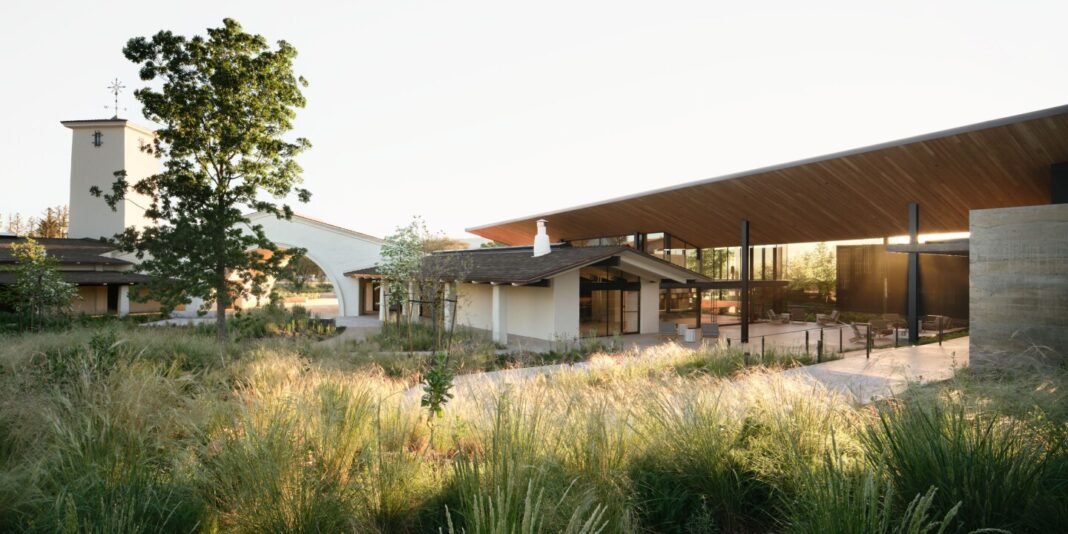


When Robert Mondavi opened in 1966, Napa Valley was much different than it is today. There were no wine trains, no Michelin-starred restaurants, no luxury spas, and no art-filled tasting rooms. But then, as now, on the horizon were the scenic Mayacamas Mountains, the great Northern California climate, and acres of old-growth vines.
After a five-year renovation, the historic Mondavi Estate reopened on April 20, adding to the winery’s trademark arches and towers a modern hospitality wing with a state-of-the-art cellar, professional kitchen and tasting room, allowing visitors to enjoy what made Napa a winemaking destination in the first place: the valley itself.
“From day one, we knew we needed to bring this back to the land,” says David Darling, co-founder of Adlyn Darling Design, the architecture firm behind the project.
Robert Mondavi, which celebrates its 60th anniversary this year, aims to modernize the facility and increase visitor numbers to the winery and Napa Valley as a whole, with a focus on hospitality. This will be a challenge as the wine industry is struggling. As fewer people drink alcohol, tourism trends in Napa have changed. Although the number of hotel stays increased last year compared to 2024 (finally surpassing pre-pandemic levels in October 2025), the overall number of tourists visiting Napa was down 10 percent from pre-pandemic levels, according to Visit Napa Valley’s CEO.
“When we started this project, the industry looked a little different than it does today when we started it,” said Peggy Hemphill, director of brand marketing at Robert Mondavi. “We want to…welcome new consumers and remind those who haven’t been here in a while of what’s special about Napa Valley. We’re really focusing on that and asking, ‘What is the unique experience?'”
Cue the scenery. An amplified connection with the terrain begins upon arrival. Landscape design firm Surface Design transformed the parking lot into a “parking meadow” planted with sweet peas, deer grass, and salvia that attracts hummingbirds. Visitors then emerge into the courtyard through the famous Clifford May-designed arch (printed on the winery’s label) before entering the living room-like reception area, part of the original 1966 building restored.
When Mondavi, who lived there from 1913 to 2008, opened his winery 60 years ago, the valley was primarily focused on production. (In 2004, the Mondavi family sold the winery to Constellation Brands, which now operates the winery.) Darling says he took a more hospitality-oriented approach and wanted guests to feel like they were in his home. That hasn’t changed. Rather, it has evolved. New experiences as part of the renovation include a glass-enclosed tasting room where guests can sample acclaimed Fumé Blanc and Cabernet Sauvignon wines, an outdoor terrace, dining areas and multiple gardens.
“One of the under-emphasized experiences in the world of wine hospitality is one rooted in the beauty of Napa Valley,” says Roderick Wiley, landscape architect and founding partner of Surfacedesign, who worked on the renovation. “I’m always amazed to see how many wineries focus on internals and production.”
As Northern California grapples with climate change and water scarcity, there’s also the added challenge of land management. In addition to doubling down on its focus on hospitality (including new exclusive experiences such as a barrel room to age wine and the option to book a private dining event in its mid-century tower), Mondavi is also increasing its investments in sustainability.
The new addition’s butterfly roof collects rainwater, and its waterfront landscape is designed to thrive during the wet and dry seasons. In short, Aidlin Darling and Surfacedesign created a water feature that resembles an aqueduct that runs through the property. When filled with water, it acts as a reflecting pool. When dry, it resembles the natural geology along the Napa River.
“We didn’t want to beat people up on sustainability or do it as a marketing strategy,” Hemphill says. “It really came from a place of understanding that we are farmers and we need land to do what we want to do. How do we act responsibly?”
These values also appeal to younger audiences who are drinking less and being more conscious about what they consume. “We know it’s important to this young consumer,” Hemphill said. “But it’s really something that’s inherently in the DNA of this winery, who we are and how we want to preserve it for the future. It feels like the best homage we can pay to Robert Mondavi’s legacy.”
While the winery is the reason for its existence, Mondavi also cared deeply about the region as a whole and the convivial culture that exists there. The renovated winery leans toward it as a destination, so both wine lovers and those who might refrain from wine can have a rewarding experience there, from tastings to simply strolling through the eye-catching grounds.
How to visit
Robert Mondavi is located in the Napa Valley town of Oakville, about 90 miles (about 75 minutes by car) north of San Francisco. Reservations are recommended, but walk-ins are welcome. Visit robertmondaviwinery.com to book your tasting, three-course culinary experience, or vineyard tour.
where to stay
Book a room at a LEED Silver rated eco-friendly hotel like Bardessono. It has 65 rooms, a rooftop pool, and is a 7-minute drive from the winery. Complimentary bicycle rental is available to facilitate a carbon-friendly stay in the valley.