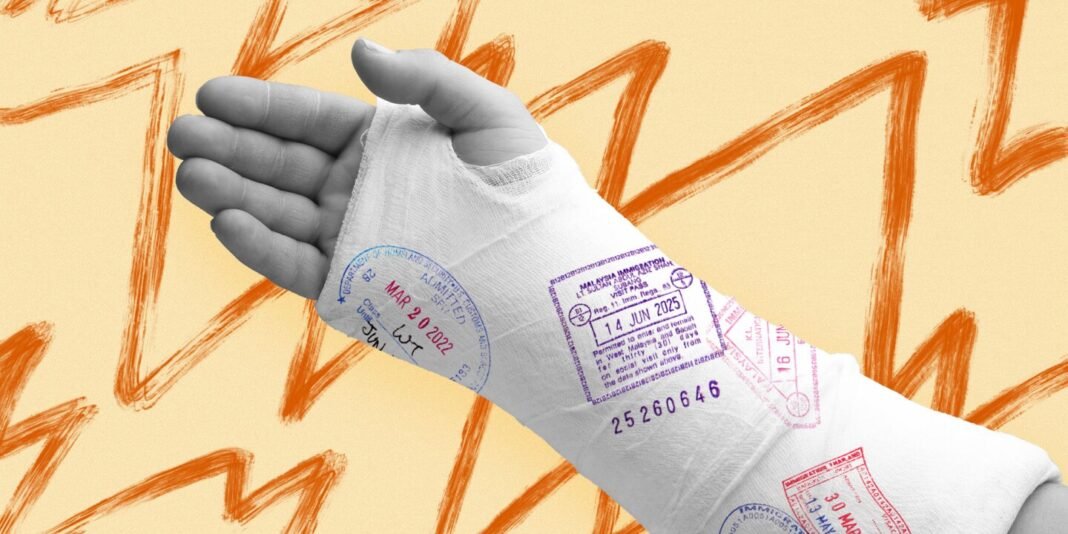


“I don’t think it’s your ACL,” my doctor at Japan’s Niseko International Clinic told me after a series of manual tests. he was wrong.
Last January, I fell while skiing in Niseko, was told to stop skiing, and left the clinic with a prescription for pain management and reminders to rest, ice, compress, and elevate. Since there was no MRI machine nearby, I accepted the preliminary diagnosis, gathered my receipts and doctor’s evaluation notes, and hoped that my travel insurance, Allianz Partners, would cover my several hundred dollars in expenses. It wasn’t until I got home that I learned I had torn both my anterior cruciate ligament and meniscus and needed surgery to repair them.
Now, a year after my recovery, I can’t help but wonder if my results would have been different, or at least the process might have been shorter, if I had had the MRI scan in Japan. But like many travelers overseas dealing with injuries and illnesses, especially non-life-threatening but disruptive intermediate ones, I too decided to tough it out, not wanting to ruin someone else’s good time.
Unfortunately, there is no handbook for situations like this. Instead, it requires a combination of getting treatment, understanding insurance, documenting everything, and making decisions along the way. However, if you’re planning a cruise or adventure overseas, heading to an area with limited medical resources, or have a pre-existing condition, travel medical insurance may provide some peace of mind. Here’s what you need to know:
What to do immediately after an injury
If you are seriously injured or become ill, seek emergency medical treatment immediately. However, for non-emergency situations, where and how quickly you should go varies greatly depending on your location.
In many destinations, emergency clinics and private practitioners can treat minor injuries more quickly and cheaper than hospitals. If you have travel insurance, your health care provider may be able to recommend a nearby tested clinic that accepts your travel insurance and can help coordinate your care. They can also tell you what your insurance policy is and what documents you need to make a claim, such as doctor’s notes, medical bills, accident and police reports, and all receipts. They may also offer translation assistance, but travelers increasingly rely on apps and the latest AirPods for real-time translation to fill in the gaps.
The U.S. Department of State recommends purchasing travel medical insurance before departure, noting that U.S. health insurance, including Medicare and Medicaid, typically does not cover medical treatment abroad. In the event of an emergency, travelers are advised to contact local emergency services directly rather than relying on embassy intervention.
What is medical care actually like overseas?
Even if they do seek care, their experience may not match what they are used to at home.
In my case, my pain management options were limited because my clinic did not have an MRI machine and Japan has strict regulations regarding opioids. What I was prescribed felt more like extra-strength acetaminophen than stronger acetaminophen. It was enough to calm my nerves, but not enough to help me move in the first 48 hours.
Such variations are common. In some countries, treatment and medication may be available on the spot. You may also come home with a prescription and directions to the pharmacy. In any case, be sure to request documentation such as doctor’s notes, receipts, scans or test results so that you can continue your treatment and file a claim later.
This document also helps in making split-second decisions. When Terry Ward, a Tampa-based travel writer, broke his collarbone in the snowy mountains of Switzerland, he chose not to undergo extensive medical treatment overseas after learning that his membership with Medget, a global air medical transportation company, would not cover his medical costs. Instead, she requested x-rays and was seen by an orthopedic surgeon upon her return home. Ward said she is considering travel insurance options and may not renew her annual Medjet membership.
When (and how) to contact travel insurance
If you have travel insurance, contact your travel insurance company as soon as possible after your injury, not just when you are ready to make a claim.
Many companies offer 24/7 support to help you find the right care, arrange appointments, and set up telehealth consultations. “Travelers often purchase plans that include medical insurance for peace of mind,” says Jeff Rowland, vice president of claims at Faye. She recommends choosing a plan that includes “24/7 human assistance” to help advance care across time zones.
In some cases, that assistance extends to direct care coordination. If you are in your insurance company’s network, your treatment may be prepaid. But in many cases, travelers must pay out of pocket and apply for a refund later.
Telemedicine has also become a more viable option in recent years. “The benefit of telemedicine is that you avoid waiting times. Appointments are scheduled at times that are convenient for the patient,” says Rolander. In my situation, a virtual visit could have helped me decide whether I should have gotten an MRI sooner or went home sooner.
What travel insurance covers (and what it doesn’t)
Coverage varies widely by provider and plan, but most travel insurance policies include a list of “covered events” and exclusions, details that aren’t always straightforward in practice.
“Make sure you have at least $50,000 in medical coverage and $100,000 in medical evacuation,” says Jenna Hammer of SquareMouth, an online travel insurance marketplace with research and comparison tools. If you’re going on a cruise or traveling to a remote location, SquareMouth recommends going even higher. At least $100,000 for medical emergencies and at least $250,000 for medical evacuation. You may also want to consider comprehensive coverage. According to SquareMouth, that’s the difference between about $90 in premiums for basic travel medical insurance and about $400 in premiums for comprehensive insurance.
“To date, the highest number of claims and payouts we receive are for travel-related illnesses and injuries,” Hammer says. “[Travelers]want to file a trip interruption claim because they don’t want to pay resort fees or the cost of the rest of their trip. In that case, the whole package is very helpful. They don’t want $50,000 in medical bills, so of course they want to have medical coverage, but they also want to have their travel expenses covered. That’s where comprehensive packages come in.”
Some premium credit cards may also include travel coverage, such as trip interruption and delay coverage, but medical coverage is often limited or excluded. If you’re using a credit card for protection, be sure to review the terms carefully before traveling. Benefits may vary.
In other words, insurance can guide your next actions, but it doesn’t necessarily make decisions for you.
Once you begin seeking treatment, documentation becomes important. Filing a claim required receipts from clinic and physical therapy sessions, a doctor’s note, proof of canceled plans, screenshots of correspondence with the hotel that initially refused to refund me, and even a credit card statement from several months ago.
The process wasn’t simple, but it worked. After my husband and I cut our trip short, we were reimbursed for our medical expenses, follow-up physical therapy, and non-refundable hotel stay in Japan.
decide whether to stay or go home
After sustaining an injury overseas, one of the most difficult decisions to make is whether to continue traveling or return home for treatment.
In the case of serious injuries, services like Global Rescue, a crisis response service, can coordinate medical evacuation, help arrange flights, and arrange for airport support such as wheelchairs and priority boarding. Because medical evacuations can cost tens of thousands of dollars or more depending on distance and level of care, many travel insurance policies include evacuation coverage as a key benefit. Please note that some services, such as evacuation memberships, focus on transportation rather than treatment, and therefore require separate medical insurance for the treatment itself.
For less urgent injuries, the decision is less clear-cut. It may depend on access to care, cost, mobility, and how comfortable you are with treatment in an unfamiliar location.
In my case, I stayed because my diagnosis didn’t seem urgent and I didn’t want to disrupt anyone else’s trip. It’s a common instinct, and it’s not always correct.
conclusion
There is no universal treatment for injury or illness while traveling. This is especially true if the situation is between a minor inconvenience and a medical emergency.
Travel insurance can provide a safety net, but it does not guarantee peace of mind. The best preparation is to understand how insurance works, know where to seek treatment, and keep detailed records of everything.
More importantly, use the information you have to make the best decisions possible. Sometimes quickly, sometimes far from home.
This article was originally published in 2024 and updated in 2026 with current information. Billy Cohen contributed reporting.