

This year, artificial intelligence (AI) has pushed the world of robotics even further, creating machines that can perform increasingly complex tasks.
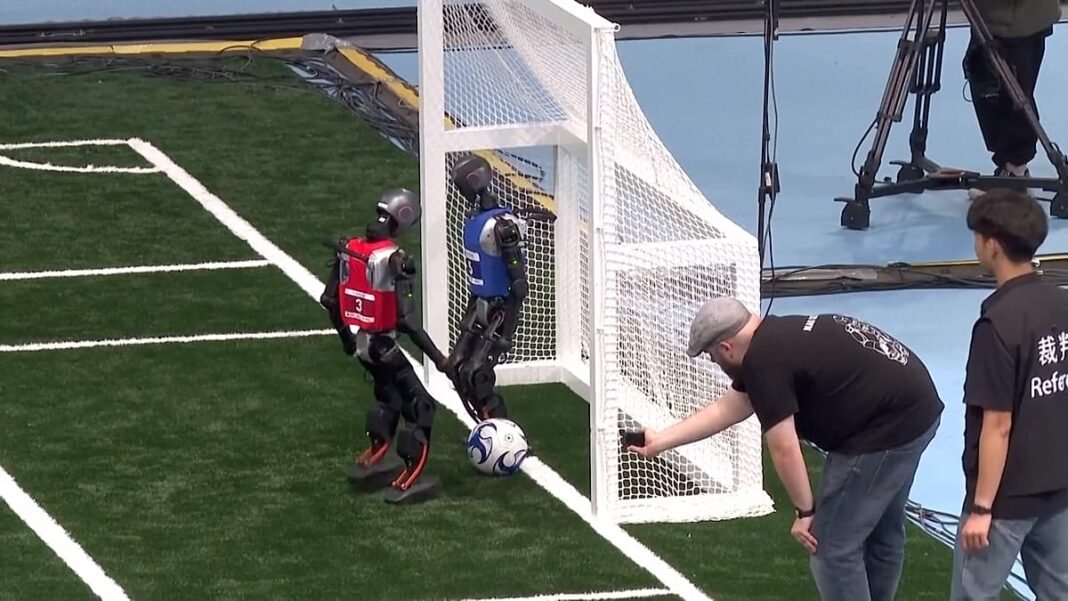
In 2025, the machine won its own sports championship at the World Humanoid Robot Games in Beijing.
Robots from 16 countries, including Germany and Italy, competed in sports such as soccer, running and boxing, showing how close they have come to replicating human movements.
Both teams competed in the 4×100 meter relay finals.
The winning team, Chinese manufacturer Unitree Robotics, completed the race in 1 minute and 48 seconds.
“We didn’t just participate in these games to win gold or silver medals. Our biggest victory is not to become the champion, but to show everyone the charisma of mass-produced robots. The most important thing is to maintain the healthy development of our industry,” said Gao Yuan, marketing manager of Unitree Robotics.
At the first International Humanoid Olympics held in Olympia, Greece in September, robots performed dance and archery skills, and a dog-like robot even jumped from a height in front of the audience.
Meanwhile, Chinese technology company XPeng launched its second-generation humanoid robot, IRON, this year.
It features a human-like spine, bionic muscles, and a body completely covered in soft skin.
The company says the robot can make autonomous decisions using three self-developed Turing AI chips with 3,000 TOPS of computing power.
The new model is expected to be introduced into service operations as early as next year.
Meanwhile, Aria, a robot developed by Las Vegas-based Realbotix, uses generative AI to interact with users.
Realbotix believes it could also work in customer-facing roles, healthcare, and education, while forming more complex relationships.
“Some companies, like ours, will focus on actually interacting with people and creating something resembling a relationship,” said Matt McMullen, founder and chief operating officer of Realbotix.
There’s also Romi, a robot designed for emotional connection but far less human-like.
Emotional support robots use AI to converse with people who are suffering from loneliness.
Robots with more practical skills are also being developed.
Panbotica, a service robot, can use machine vision to make coffee comparable to that made by baristas.
Meanwhile, the 4NE1 robot developed by Neura Robotics can sort laundry.
The developers are also positioning it as a companion for the elderly.
“We want people to be able to stay at home longer without being forced into caregiving, because they feel safe at home. They have a companion to help them with all the tasks, but also the peace of mind that if they fall, someone will be there to help them,” said David Reger, CEO of Neura Robotics.
For more on this story, watch the video in the media player above.
video editor •Roselyn Min