

Release date
In astronomy, researchers surprisingly james webb space telescope (JWST) has detected complex organic molecules, often referred to as “seeds of life,” outside our galaxy.
Launched in 2021 in collaboration with NASA, the European Space Agency (ESA), and the Canadian Space Agency (CSA), JWST is the largest, most powerful, and most sophisticated telescope ever sent into space.
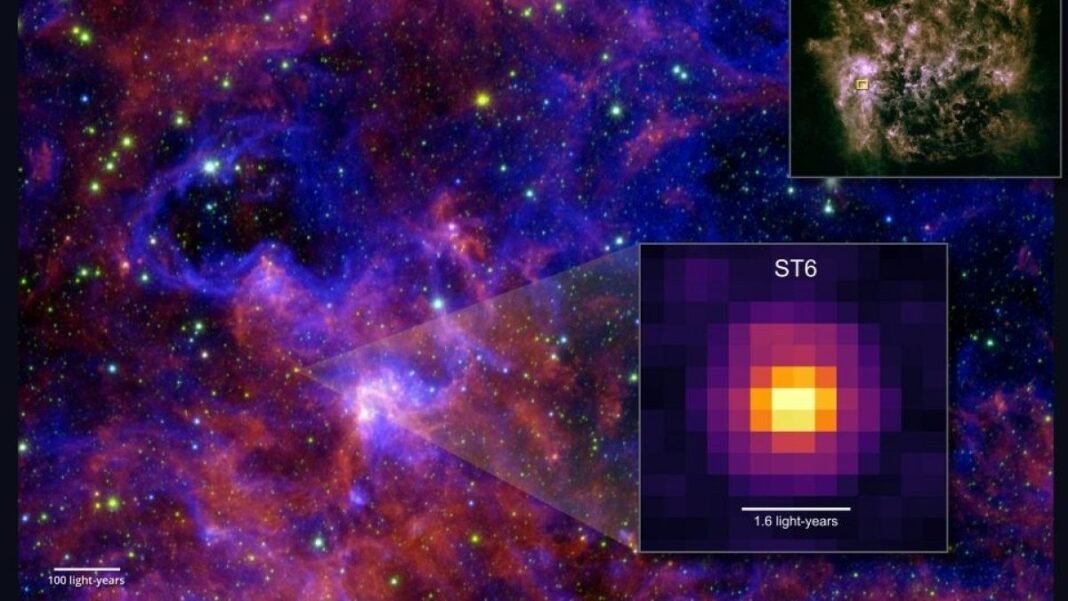
The discovery was made in the frozen ice surrounding a young star named ST6 in a distant galaxy. These molecules include known compounds such as alcohol and the main component of vinegar (acetic acid), which are the building blocks of life on Earth.
What makes this discovery particularly noteworthy is that the galaxy in question has far fewer heavy elements than the Milky Way and is exposed to intense ultraviolet light. radiationcreating a harsh environment in which such molecules typically struggle to survive.
History of discovery
A research team led by University of Maryland scientist Marta Sewilo used JWST’s powerful Mid-Infrared Instrument (MIRI) to peek into our galaxy’s closest neighbor, the Large Magellanic Cloud, about 160,000 light-years away.
Focusing on the giant clouds of dust and ice where new stars are forming, we discovered spectral signatures of some complex organic molecules, also known as COMs.
The molecules identified included methanol, ethanol, methyl formate, acetaldehyde, and acetic acid.
The researchers said this marks the first confirmation of ethanol, methyl formate and acetaldehyde in ice beyond the Milky Way, although acetic acid had never been “definitively” observed in space before.
The researchers also discovered spectral features similar to another ice COM, glycolaldehyde. Glycolaldehyde is a sugar-related molecule that is a precursor to more complex biomolecules, such as components of RNA.
why is it important
This discovery is important because it proves that COM can form even in extreme interstellar environments.
Co-author Will Rocha of Leiden University in the Netherlands said COMs could form on interstellar dust particles found in both ice and gas. Once formed, ice COM can be released into the surrounding gas, and these reactions are likely the main way such molecules are produced in the Universe.
“The detection of COM in the ice confirms these results,” Rocha said in a statement.
“The detection of icy COMs in the Large Magellanic Cloud provides evidence that these reactions can effectively generate them in much harsher environments than near the Sun.”
Professor Sewiro added that studying the COM of the Large Magellanic Cloud is particularly valuable. This is because they are less metallic and contain less heavy elements such as carbon, nitrogen, and oxygen, making them similar to galaxies in the early universe. “The harsh conditions tell us more about how complex organic chemistry can occur in these primitive environments, where there are far fewer heavy elements such as carbon, nitrogen and oxygen available for chemical reactions.”
Although this does not confirm that life exists elsewhere, the discovery suggests that the building blocks of life may survive the formation of planetary systems and seed early planets.
Professor Sewilo hopes to expand his research to more protostars in both the Large and Small Magellanic Clouds to better understand how complex chemistry occurs in the Universe.