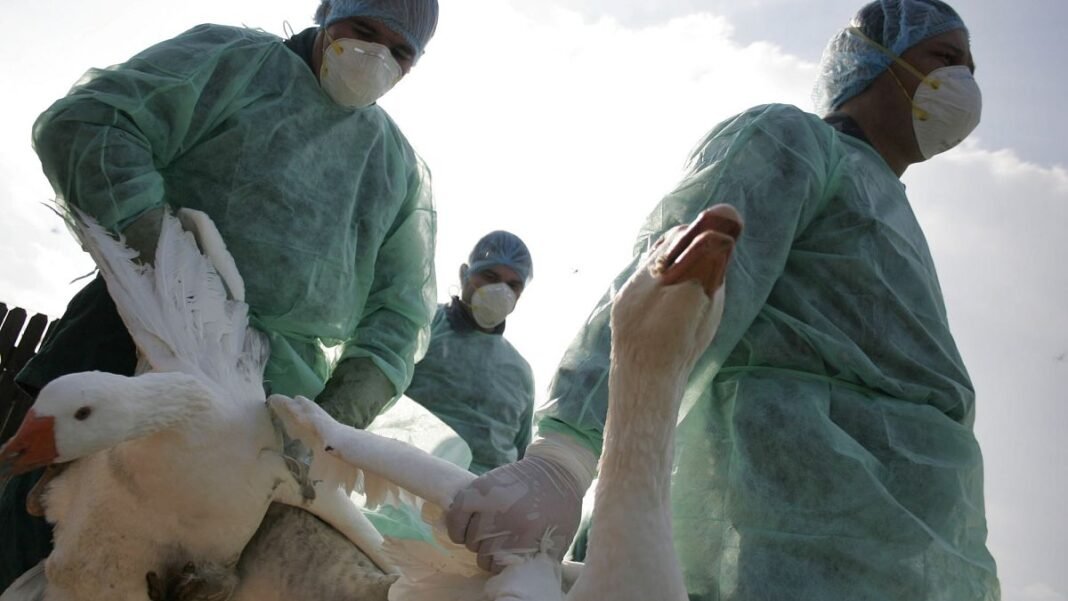


A group of scientists has created a simulation that shows how bird flu could spread to humans if proper vaccination and quarantine measures were not taken.
Researchers have widely warned about the possibility of future pandemics caused by what they call “Disease X,” an infectious disease that originates in animals and later infects humans.
As World Health Organization (WHO) experts have warned, one such disease candidate is highly pathogenic avian influenza (HPAI), commonly referred to as avian influenza.
The study, conducted by Ashoka University and published in BMC Public Health, examines how quickly an epidemic spreads after human-to-human transmission begins.
According to the European Center for Disease Prevention and Control (ECDC), there have been no reports of this happening so far.
Health officials said in their latest report this month that the scale and geographic scope of these detections is unprecedented for this time of year, especially in wild birds.
Avian influenza has been circulating at high levels around the world, including in wild and agricultural birds within the European Union, over the past five years. In recent years, the virus has spread to minks, cats, captive bears and other mammals, increasing the risk that the virus could eventually reach humans.
This simulation recreates a small village in the southern Indian state of Tamil Nadu. The region is home to more than 1,600 poultry farms housing more than 70 million chickens.
Scientists started with a small number of infected birds and no infected humans. They recreated an outbreak on a poultry farm and presented two scenarios. If infected birds are quickly contained, humans cannot be infected. However, if culling is not done or culled too late, several workers will become infected.
In many simulation scenarios, nothing happens. The virus cannot reach humans, especially if infected birds are killed early. The herd is therefore removed before the infection peaks, reducing the risk to humans to zero.
However, in other areas, one or two farmworkers may be infected for about seven days after a three-day incubation period, returning home each night and infecting their families.
Simulations show there is a small window of time, between about two and 10 detected cases, during which the virus can be brought under control before it leaks into the wider community.
If households are isolated at the beginning of an outbreak, the virus is likely to be contained.
But if the number of infected people reaches 10, simulations show that some infected household members have already gone to work or school and are transmitting the virus to others.
At this point, the virus has entered the wider population, creating new, independent chains of infection that cannot be fully stopped even by isolating the original household.
Mathematically, if isolation of infected persons is delayed by 10 cases, the estimated reproduction rate and epidemic curve are very similar to the “no early intervention” scenario. This is because much of the forward spread has already occurred.
The findings have led researchers to stress the need to act before community transmission occurs, after which only widespread measures such as lockdowns and mass vaccination will be effective.
This simulation has several limitations, primarily the multiple co-occurrence locations, behavioral changes such as the use of personal protective equipment after an avian outbreak is noticed, and the failure to include mammalian intermediate hosts.