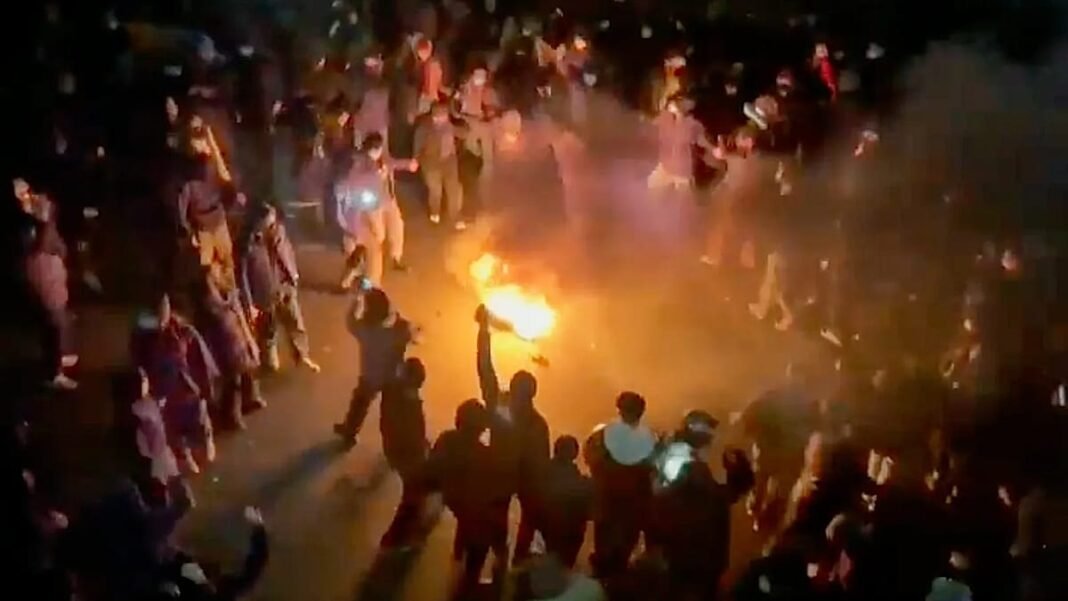


Iran on Monday summoned diplomats in Tehran representing France, Germany, Italy and the United Kingdom to protest the countries’ purported support for protests rocking the Islamic Republic, the Iranian Foreign Ministry said.
The ministry said in a statement carried by state television that the diplomats were shown videos of damage caused by “rioters” and had instructed their governments to “withdraw public statements in support of the protesters.”
Wave of criticism from Western governments follows Norway-based government The Iranian Human Rights Group (IHR) said on Monday: At least 648 protesters have been killed in a crackdown by Iranian security forces against the protests.
The group warns that the actual number of victims could be much higher.
“The international community has an obligation to protect civilian protesters from mass murder by the Islamic Republic,” IHR Director Mahmoud Amiri Moghaddam said, commenting on the new death toll confirmed by the NGO.
“According to some estimates, more than 6,000 people may have been killed,” the IHR said, but warned that the nearly four-day internet blackout imposed by Iranian authorities made it “extremely difficult to independently verify these reports.”
condemnation of the west
French President Emmanuel Macron condemned what he called “state violence” targeting Iranian protesters.
“We condemn the state violence that indiscriminately targets Iranian women and men who courageously demand respect for their rights,” Macron wrote to X.
“Respect for fundamental freedoms is a universal requirement and we stand with those who defend freedom.”
German Chancellor Friedrich Merz said Iran’s use of “unjust and brutal violence” against demonstrators was a “sign of weakness”.
“We condemn this violence in the strongest possible terms,” Mertz said during a visit to India. “This violence is not an expression of strength, but rather of weakness.”
In Berlin, a Foreign Ministry spokesperson said Germany continued to push for Iran’s Islamic Revolutionary Guard Corps to be “registered in the EU’s anti-terrorism sanctions regime.”
He said Berlin was “working within the EU to reach a consensus” on imposing sanctions on the Revolutionary Guards, the ideological wing of Iran’s military.
Meanwhile, British Foreign Secretary Yvette Cooper called for an end to Iranian authorities’ violent crackdown.
“The killings and brutal crackdown on peaceful protesters in Iran are horrifying,” Cooper said in a post on X.
“I spoke to (Iran’s) Foreign Minister (Abbas) Araghchi and told him directly that the Iranian government must immediately stop the violence, protect fundamental rights and freedoms and ensure the safety of British people.”
The EU said in a statement that it was “considering” imposing additional sanctions on Iran over its crackdown on protests.
“Following the violent crackdown on protesters, we stand ready to propose new and tougher sanctions,” EU spokesman Anuar El-Anouni said.
currency collapse
The protests were sparked by the closure of Tehran’s bazaar on December 28 in response to the deteriorating economy, with the rial currency falling to record lows.
The movement quickly spread from outside the capital to other parts of the country, with demonstrators demanding regime change, posing one of the most serious challenges to the country’s theocracy since the 1979 Islamic Revolution.
Some demonstrators chanted “Death to the dictator!” and “Death to the Islamic Republic!” while others burned photos of Khamenei.
Internet access and phone lines were cut off almost immediately after the protests began, with internet company Cloudflare and advocacy group NetBlocks both reporting outages as the result of Iranian government intervention.
take back the story
In an effort to regain control, the government on Monday called for a nationwide rally in support of the Islamic Republic.
Thousands of people gathered in the capital’s Enherab (Revolution) Square, state television said, waving national flags and reading prayers for the victims of what the government called “riots.”
Iran’s supreme leader Ayatollah Khamenei praised the pro-government rally and said the vote was a “warning” to the United States.
“This is a warning to American politicians to stop deceiving and not to rely on traitorous mercenaries,” Iranian state television said after US President Donald Trump repeatedly threatened military intervention if the Iranian government killed protesters.
“These large, determined rallies thwarted foreign enemy plans that would have been carried out by domestic mercenaries,” he said.
The speaker of Iran’s parliament, speaking at a rally in Tehran, described the response to the wave of protests engulfing the country as a “war against terrorists.”
Mohammad Berger Ghalibaf said Iran is fighting a “four-front war,” citing an economic war, a psychological war, a “military war” with the United States and Israel, and “today a war against terrorists.”
“The great Iranian nation has never allowed its enemies to achieve their goals,” he said, adding the slogan “Death to Israel, Death to America” in Farsi, and vowed that Iranian forces would teach US President Donald Trump “an unforgettable lesson” in the event of another attack.