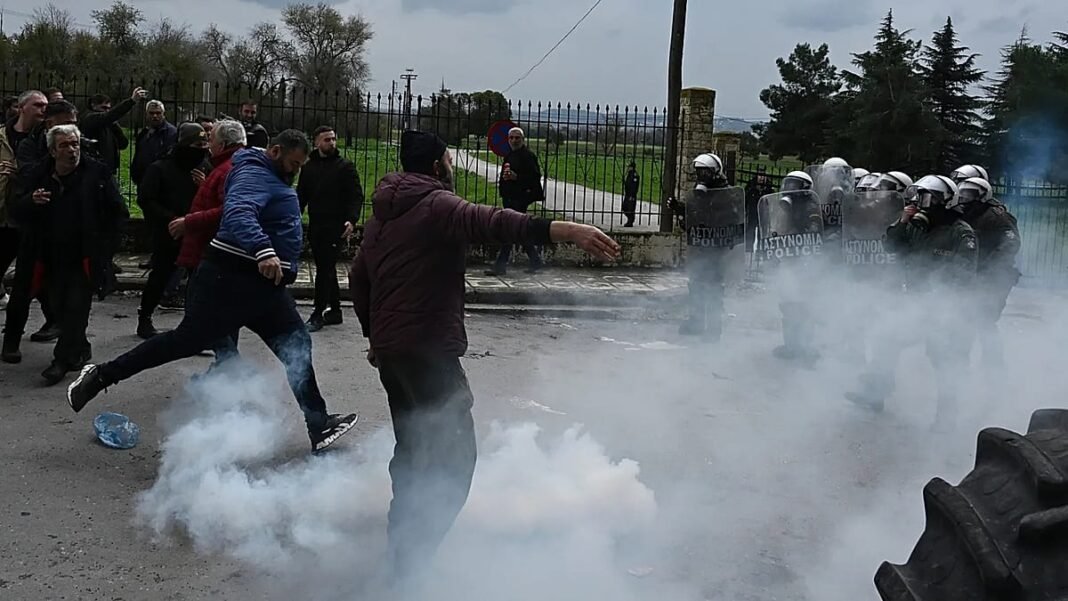


Greek riot police fired tear gas on Friday at farmers who tried to block a main access road to Thessaloniki’s international airport as protests intensified over delayed payments of European Union-backed agricultural subsidies.
Angry farmers have deployed thousands of tractors and other farm vehicles at border crossings and strategic points along highways across the country, regularly halting traffic and threatening to completely block roads, airports and ports.
In the northern city of Thessaloniki, 200 to 300 farmers and more than 100 tractors blocked one of the roads near the airport.
A small group used tractors to break through a police cordon and attempt to block the airport’s main access road. This would prevent travelers from entering and exiting the facility.
Police are enforcing traffic diversions in several regions in northern and central Greece to avoid the blockade.
Farmer barricades along the northern border with Bulgaria, Türkiye and North Macedonia are already blocking traffic and causing backups for cargo vehicles.
The payment delays come as authorities scrutinize all claims for EU agricultural subsidies following revelations of widespread fraud.
Protesters say the delay amounts to collective punishment, leaving honest farmers in debt and unable to plant rice for next season.
Greece’s agricultural sector has also been hit this year, with outbreaks of goat pox and sheep pox causing mass culling of livestock.
Government is open to talks
“We should be sowing, but we are in the streets (protesting). We are bankrupt,” said farmer Vasilis Mavroskas.
Not being able to plant crops would have a knock-on effect on the food supply to cities, he said. “At the moment it’s about survival. Think about what will happen to our city centers if we stop producing. We’re calling on society to get involved.”
Security Minister Michalis Krishokoidis said this week that the government was open to talks with protest leaders, but warned that it would not tolerate shutting down major transport links.
Christos Tsilias, vice president of the Thessaloniki Farmers’ Union, called on the public to support the farmers’ demands and put pressure on the government to waive the payments.
“At the moment, the plains of Thessaloniki (and near Chalkidiki) are not reforested,” he said. “I don’t have money to buy raw materials” such as seeds and fertilizer.
Farmer protests have been frequent in Greece, and similar blockades have been in place in the past, sometimes cutting off all road traffic between the country’s north and south for weeks.
Five senior government officials resigned in June following the subsidy scandal, and the state agency that handles agricultural subsidies was gradually shut down.
Dozens of people have been arrested on suspicion of making false claims in response to an investigation led by the European Public Prosecutor’s Office (EPPO).
According to the EPPO, preliminary investigations have revealed that around 324 people are beneficiaries of subsidies totaling 19.6 million euros.
The EU’s independent body for fighting financial crime announced in late October that the investigation was linked to a “organized large-scale subsidy fraud scheme and money laundering operation”.
Additional sources of information • AP