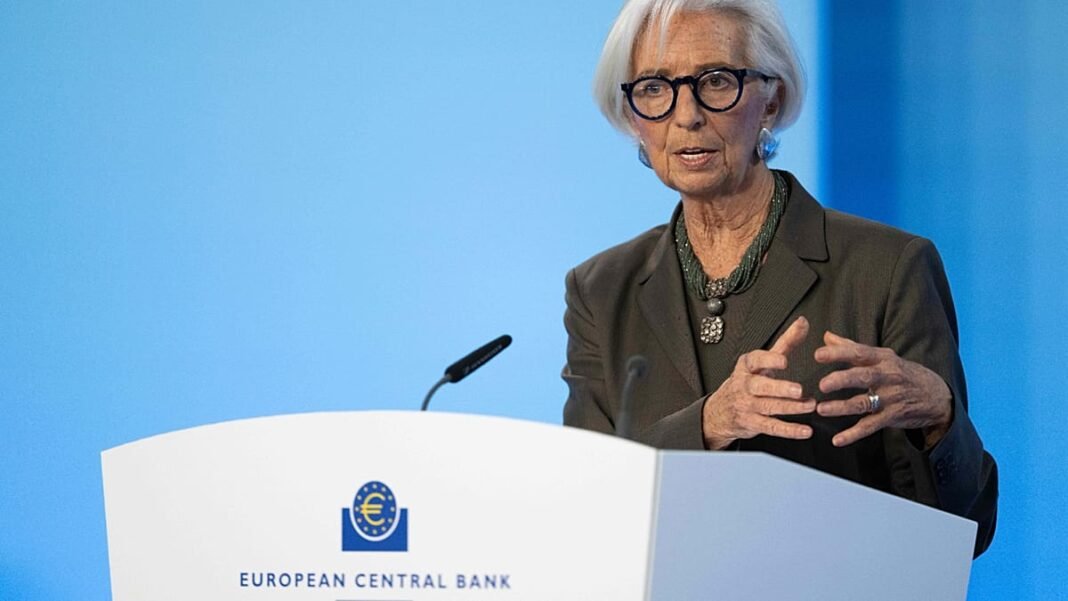


The European Central Bank kept interest rates on hold on Thursday, with President Christine Lagarde saying policymakers were “in a good situation” despite inflation being below target and stressing that the ECB “cannot be held hostage to a single data point” as it sticks to a data-driven, meeting-by-meeting approach.
Bulgaria becomes the 21st member of the euro area
The meeting began with a symbolic gesture in which the ECB welcomed Bulgaria’s entry into the eurozone, which will take effect from January 1, 2026. Dimitar Radev, Governor of the National Bank of Bulgaria, joined the ECB Board with voting rights, marking the culmination of Bulgaria’s long journey towards monetary union.
Lagarde hailed the accession as further evidence of the “attractiveness of the single currency and the lasting benefits of European integration.”
Since 1999, the membership of the euro area has almost doubled and there are now 21 countries.
Inflation will fall, but disinflation is likely to be temporary
Eurostat’s preliminary estimates showed that the inflation rate in the euro zone was 1.7% in January, down from 2.0% in December and 2.1% in November. This decline was mainly due to a sharp decline in energy prices, which fell by 4.1% year-on-year.
Core inflation (excluding food and energy) fell to 2.2%, the lowest level since October 2021, while services inflation slowed to 3.2%.
However, food inflation rose slightly to 2.7%. Lagarde downplayed concerns of excessive disinflation, attributing much of the decline to base effects and stressing that the headline numbers would not change the ECB’s medium-term inflation trajectory.
“We can’t be hostage to one data point,” she said.
Several questions probed whether the ECB’s language had become more hawkish.
Lagarde rejected this label, arguing that the policy was “agile” rather than directional.
Economic growth supported by AI, infrastructure and defense
Eurozone GDP increased by 0.3% in the fourth quarter of 2025, mainly driven by services, particularly information and communications technology (ICT) and AI-related sectors.
In response to a question about artificial intelligence, Lagarde refuted the idea that Europe was lagging behind, pointing instead to increased private investment in AI-related activities.
He described ICT investment as the “big story” behind the resilience of domestic demand, stressing that it goes far beyond just software and also includes data centres, hardware and support infrastructure.
Importantly, Lagarde frames AI, at least for now, as a potential productivity dividend rather than an inflationary risk.
Construction activity also gained momentum due to public investment in defense and infrastructure.
Labor market data showed some improvement, with the unemployment rate falling slightly to 6.2% from 6.3% in December. Although labor demand has cooled, the ECB sees no signs of imminent stress and continues to monitor wage developments closely.
Euro appreciation will be monitored but not a target
Responding to a question about the euro’s strength against the dollar, Lagarde stressed that the ECB does not target the exchange rate, but rather takes into account the impact on inflation and growth.
“We keep a close eye on developments in exchange rates,” he said, adding that the recent appreciation of the euro “is factored into our baseline.”
“There is no fatal correlation between being a global currency and being appreciated relative to other currencies,” she added.
He also said the ECB would send a “checklist” of reforms to EU leaders ahead of the competitiveness summit on February 12, urging them to act on long-standing priorities.
This checklist outlines reforms that the ECB considers important for promoting growth, productivity and the euro’s international role, including completing the capital markets and banking union, introducing a digital euro, deepening the single market, promoting strategic autonomy and improving the EU’s institutional framework.
“I feel strongly that if Europe is to realize its potential, important reforms need to be deepened or accelerated,” Lagarde concluded.