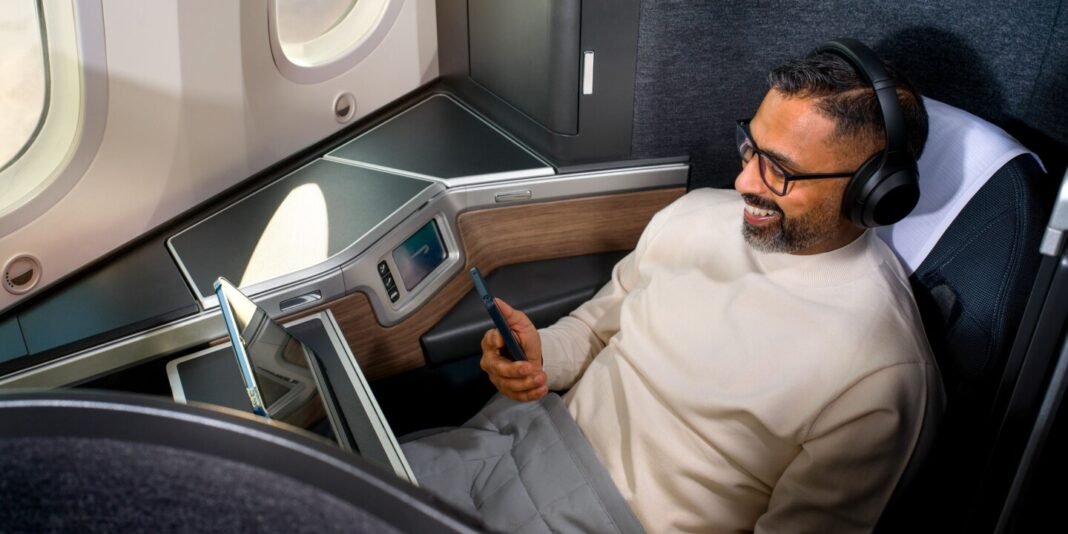


Your next long-haul flight could introduce a new type of background noise: someone else’s phone call.
British Airways is now allowing in-flight voice calls on its Starlink Wi-Fi-equipped aircraft, marking a shift in what is possible and what is considered acceptable in the skies. The company’s first Starlink-equipped flight took off on March 19, beginning a broader rollout that will see the technology installed on more than 300 aircraft over the next two years.
Under new settings announced on British Airways’ website, passengers will be able to make phone calls as long as they “keep their voices low and use headphones”.
British Airways is not the first airline to use Starlink. Starlink uses low-Earth orbit satellites to provide high-speed internet with significantly lower latency. This makes real-time communication practical in a way that was not possible with previous systems. A growing number of airlines, including U.S.-based United Airlines, Hawaiian Airlines, and Alaska Airlines, are upgrading their in-flight Wi-Fi systems to take advantage of the service, but voice calls are not yet available. In other words, technology is no longer the limiting factor, but rather how airlines choose how to use it.
Long-standing ban, at least in the US
For travelers accustomed to flying within the United States, the idea of making a phone call at 30,000 feet can literally sound shocking. In-flight voice calls are still effectively prohibited in domestic airspace. The Federal Communications Commission bans traditional cell phone voice calls on airplanes, a rule that stems from concerns about interference with ground networks. This restriction specifically applies to the use of a mobile phone’s cellular connection in the air, as opposed to internet-based calls over Wi-Fi. The Federal Aviation Administration has historically supported limits on onboard equipment out of an abundance of caution, even though advances in aircraft systems have alleviated many of the initial safety concerns.
Even though Wi-Fi on planes has improved, making it easier to send text messages, emails and streams during flights, U.S. airlines have shied away from allowing voice calls, citing passenger comfort and in-flight noise management challenges. This also includes flights where major carriers offer connectivity. For example, Delta Air Lines offers free Wi-Fi to many of its passengers through a partnership with T-Mobile, and American Airlines offers access on some routes with AT&T. Messaging and browsing are still allowed in these cases, but voice calls on apps like FaceTime and Zoom are usually blocked or discouraged. This is not because federal law explicitly prohibits them, but because airlines choose not to allow them.
Congress is also considering the issue. In 2018, U.S. lawmakers drafted a bill aimed at banning airlines from allowing voice calls over Wi-Fi, effectively codifying what was already standard practice. But “the final rule was never actually adopted,” said Gary Leff, an aviation expert and author of the blog View from the Wing.
However, rules are lax in many parts of Europe. Regulators such as the European Union Aviation Safety Agency are allowing airlines to decide how in-flight connectivity is used, including whether to allow voice calls over Wi-Fi. The European Commission will also advance plans to enable 5G connectivity on aircraft, providing airlines with the infrastructure to provide a more seamless, always-on experience.
“The bigger question is how British Airways intends to alleviate the growing frustration that other travelers are feeling,” Katie Nastro, a travel expert at Going, which offers airline deals newsletters and apps, told Afar. “Even a reclining seat a few inches away from another passenger’s space can spark an argument. Imagine what could happen over a few conference calls during a flight.”
expert opinion
Some industry analysts say the question now is not whether the technology will work, but who will decide how it will be used.
“This seems like something that should be in the hands of the airlines, not the government,” Leff said. “Probably no major airline would allow calls, but decision-making and enforcement against calls (as opposed to criminally egregious activity) should not be delegated to the government. Most people hate the idea, so I’m in the minority who think it’s probably okay and shouldn’t be illegal anyway.”
Others are more skeptical and point out the realities of communal cabin environments.
“The beneficiaries are business people and socially savvy people who are glued to their phones and laptops,” Nastro said. “The losers are all the other passengers who are invited to their call, and there is no reject button.”