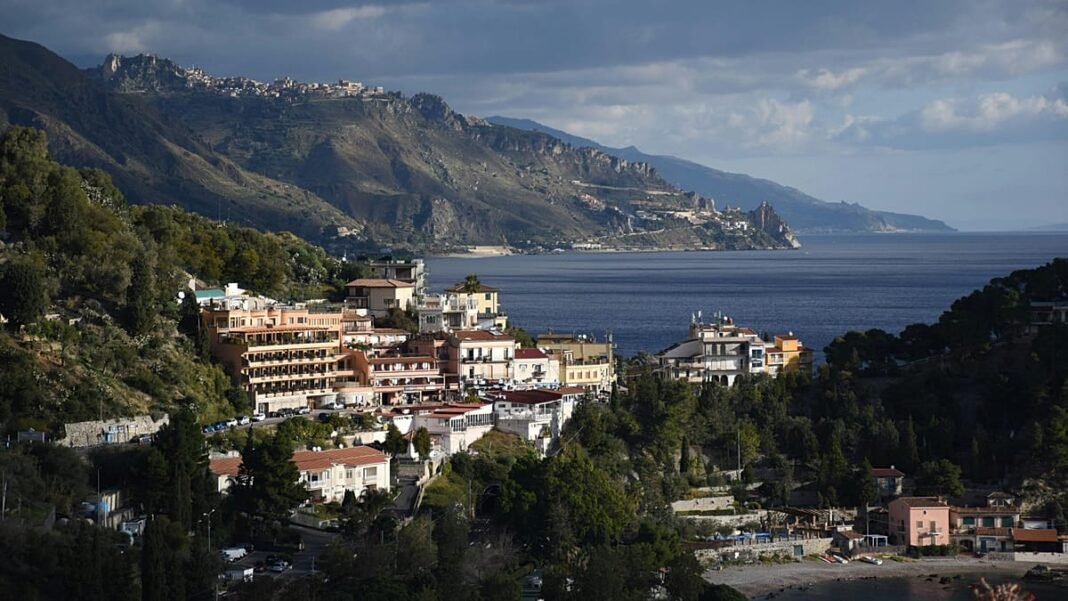


While the world’s attention is focused on the World Economic Forum in Davos, where leaders are grappling with Donald Trump’s tariff threats against Greenland, another European island is facing a devastating economic shock.
Sicily, the Mediterranean’s largest island, is assessing the impact of Cyclone Harry after days of high waves and heavy rain pounded Ionia’s eastern coast, destroying public infrastructure, damaging homes and disrupting the tourism economy that provides much of the region’s income.
On the night of January 20th and 21st, waves reached heights of more than 12 meters off the eastern coast of Sicily, an unprecedented phenomenon in Italy and the Mediterranean Sea.
Preliminary estimates by local authorities put public sector-related losses at 740 million euros, a figure that is expected to rise to well over 1 billion euros once losses to hotels, restaurants and related services are fully taken into account.
In an exclusive interview with Euronews, Cateno de Luca, mayor of Taormina, one of southern Europe’s most valuable tourist destinations, said damage alone to public works in nearby coastal cities such as Letoianni, Santa Teresa di Riva, Mazzeo, Roccalmela and Giardini Naxos was estimated at around 100 million euros.
“This number only covers infrastructure,” De Luca said, citing additional losses to power and water networks, wastewater treatment plants and dozens of beachfront homes.
Despite the scale of the destruction, no deaths were recorded. Mr De Luca attributed this result to the effectiveness of local civil protection alerts and emergency assistance.
Emergency measures and financing risks
The Sicily regional government has already started the formal process of requesting a state of emergency, which is expected to be approved by Italy’s Council of Ministers within the next few days.
Italy’s Minister of Civil Protection Nero Mussi visited the affected areas on Wednesday to assess the damage firsthand.
De Luca urged Rome to enshrine emergency procedures in its decree to speed up recovery, warning that bureaucratic delays could compound economic damage.
“The amount of money is important, but the way it is spent is even more important,” he said, calling for local governments to act as implementing authorities rather than creating centralized emergency agencies.
Asked whether Italy could seek support from the European Union Solidarity Fund, De Luca said the conditions were clearly met. Such funding would target both infrastructure repairs and long-term mitigation works.
The Solidarity Fund was established to respond to major natural disasters in Europe, but to receive funding the extent of damage must meet relevant criteria.
“These are structurally weak areas,” De Luca said. “If we rebuild without addressing the causes, the region will be exposed to the same risks.”
He also acknowledged that Sicily has historically struggled to utilize EU funds fully and efficiently compared to other European regions.
Is tourism at risk this summer?
Sicily’s economic outlook remains fragile. De Luca warned that large parts of the coastline may not be fully restored by next summer, increasing the risk of lost reservations, job losses and ripple effects across the local economy.
“The priority is to avoid chain collapse,” he said, pointing to the potential for tourism to spill over into hospitality, transport and household incomes. “We must act now,” he added.
Looking to the future, De Luca sought to reassure tourists, investors and international businesses.
He said Taormina’s municipal government has the financial and administrative capacity to respond quickly, pending regional and national support.
“Taormina has gained international recognition and market share in recent years,” he said. “We will do everything we can to protect that brand, maintain the quality of service and return to normality as quickly as possible.”
Although the coming months are expected to be difficult, local authorities insist that recovery efforts have already begun, with big bets not only on infrastructure but also on Sicily’s broader economic resilience.