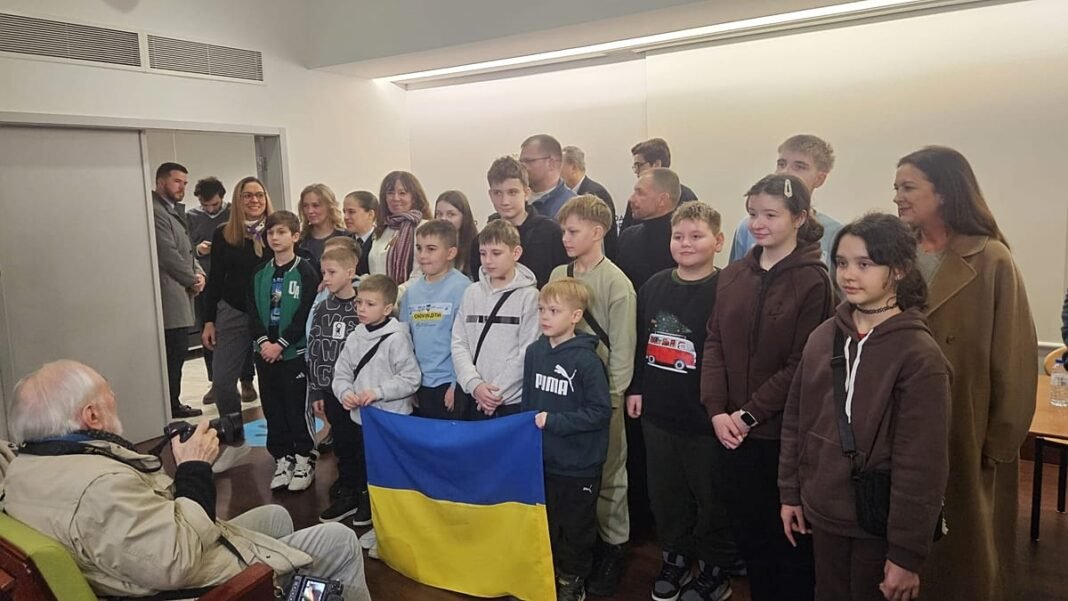


A group of 15 Ukrainian mothers and 18 children, relatives of soldiers killed or missing in action, landed at Lisbon airport just after 4pm on Saturday. They arrived in Portugal with suitcases and luggage and enjoyed three weeks of peace.
This initiative was brought about by the Ukrainian support organization “HelpUA.PT – Ukrainian Refugees UAPT” as part of the European program for psychological and cultural support for families during war.
The program aims to provide “intensive psychological rehabilitation, cultural integration and personal training” and will be run entirely under the “permanent presence of Portuguese and Ukrainian psychologists, therapists and volunteers.”
The journey began in Ukraine. The group, which included children between the ages of 5 and 14, set out from the Chernihivska region in northern Ukraine, close to the border with Russia, where the conflict is raging and one of the most active front lines.
They traveled overland to Poland and took a flight from Warsaw to Lisbon.
“It took us 20 hours by bus,” explained Angelo Neto, vice president of HelpUA.PT. “We finally reached the border thanks to Ukrainian military police escorting the bus and clearing the closed road.”
The group arrived to spend three weeks in peace, engaging in activities focused on rehabilitation, civic and cultural integration.
“We sincerely hope that the children can experience peace during their time here,” said Justice Minister Rita Giudice, who was at the airport on behalf of the government.
“Having a normal experience, because many children between the ages of six and 14 have no memories of anything other than war,” she added.
“And to be able to give them a normal experience, to be able to be a child, to be a mother, to be a grandmother, to be able to have a grandmother, that’s what Portugal can do for this group here at this stage.”
“As Minister of Justice, I cannot help stressing that this welcome is also an affirmation of values, because justice does not end in court. Justice can also be lived in the sense of upholding human rights, protecting the most vulnerable and not normalizing violence against anyone, especially children,” the Attorney General said.
Giudice also praised the project as a “remarkable” civil society initiative, stressing that “the Portuguese government maintains its resolute and continued support for Ukraine, both in humanitarian, political and international terms.”
“Courage runs in their blood.”
The group’s ambassador, Teresa Real Coelho, a former Social Democratic lawmaker who traveled to Ukraine with the group, explains that these families come from war-torn cities but still want to maintain ties to their homeland.
“Courage runs in their blood. Their resilience is amazing. There are now curfews in many of these towns,” she explained to journalists.
“They don’t want to leave the area where they live, they want to maintain ties with the area where they live, and despite the war, despite spending many nights in underground bunkers, they continue to live a normal life.”
The group that arrived in Portugal was carefully selected by the Ukrainian Ministry of Defense.
“Naturally, we cannot choose for ourselves. We do not know all the realities, but in this case the request from the Ministry of Defense of Ukraine was to choose families from the areas most affected by the war,” Coelho said.
These children will stay at Ouren’s Phoenix Center for three weeks. In 2024, the center will accept a group of combatants and war-wounded soldiers for rehabilitation. They then return to their normal lives after that period, as they wish.
“They will return to their hometowns and continue their lives,” said the group’s ambassador.
“In other efforts that we have done, for example, in refugee centers that were initially set up to take in children and mothers, they were integrated for eight and a half months, and after a while they all said, ‘No, I want to go home, I want to be with my husband and my father, I want to know what’s going on.’ So what I mean is, this is courage in their blood, and they are defending our freedom and Europe,” Coelho said.
Angelo Neto, Vice President of HelpUA.PT and Director of the Phoenix Center, emphasized the importance of the project for the rehabilitation of these people currently arriving in Portugal, adding that they aim to undertake similar projects in the future.
“We are talking about around one million vulnerable mothers in Ukraine. This project started in the UK and has welcomed 400 families in 2025, and I, on behalf of Portugal, hope that number will exceed 500.”