

As the world transitions from welcoming a new year to the first weekend of 2026, some social media users noted a sudden spike in pizza sales around the Pentagon early Saturday morning, which was interpreted in informal online circles as a sign of imminent action by the United States elsewhere in the world.
Then came the attacks on Venezuela starting Saturday night, surprising many who did not expect the new year to begin with the arrest of Venezuelan leader Nicolás Maduro.
But in reality, there was no interruption. Several important geopolitical developments around the end of the year have refocused attention on U.S. foreign policy and its impact on America’s allies and adversaries, from Venezuela to Iran to Syria and beyond.
New year, familiar message
Even early in the new year, US President Donald Trump did not hold back from sending a clear message against the Islamic Republic of Iran.
His statement came alongside important developments in Latin America and Africa, from the attack on Caracas and the fall of President Maduro to a military operation against a stronghold of the so-called Islamic State militants in northern Nigeria, said to have been carried out at the behest of that country’s government.
Some analysts point out that Iran, Venezuela, and Nigeria are all oil producing countries. With global energy markets sensitive, questions have arisen as to whether the United States is seeking to take a more active role in the oil equation and even influence OPEC.
However, Venezuelan oil industry officials announced that major facilities in the country, which has the world’s largest proven oil reserves, were undamaged and production and refining continued.
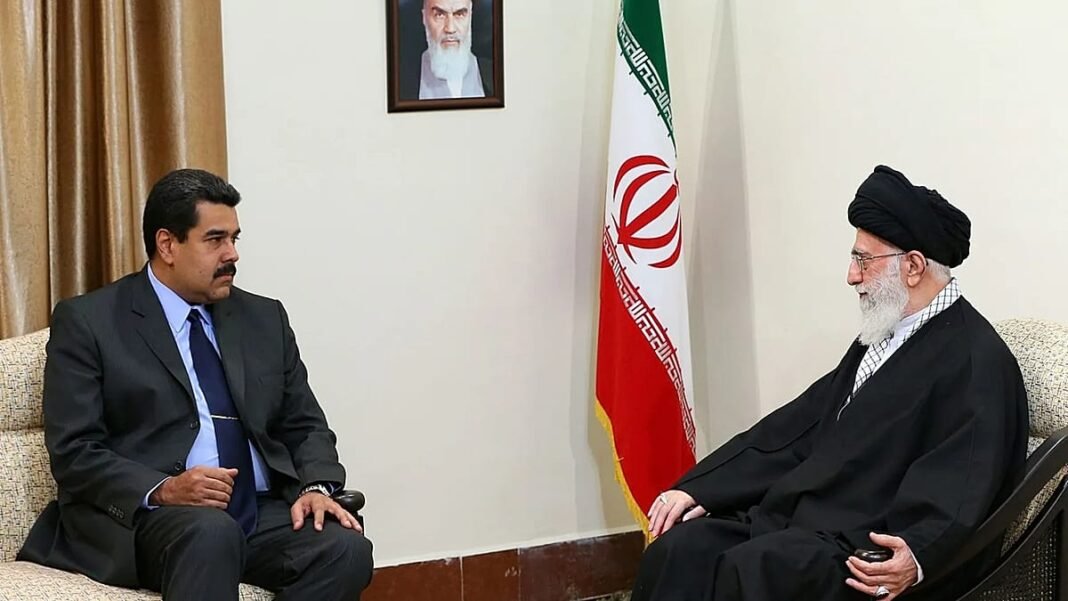
Maduro’s collapse is not thought to be limited to internal turmoil in Venezuela. The event has a double meaning for Tehran, as Venezuela has become a close ally of Iran in recent years, with extensive economic, oil and security cooperation forming between the two countries.
From the close ties between Tehran and Caracas during the era of President Mahmoud Ahmadinejad and the relationship with the late Venezuelan President Hugo Chávez, to the Iranian government’s economic and logistics plans in Venezuela.
These alliances often involved billions of dollars in Iranian investments, particularly from Revolutionary Guards affiliates, but were primarily based on ideological affinities and common opposition to the United States.
The fate of these investments and Iran’s deferred fiscal claims remains uncertain, even as Iran itself faces a severe economic crisis and a shortage of foreign currency due to the fall of the Maduro regime.
Iranian protests and the shadow of overseas expansion
The development comes at a time when street protests in Iran with messages of support for President Trump have entered a new phase, spreading to many cities across the country.
The recent protests in Iran, triggered by a severe economic crisis and the disruption of people’s daily lives, are not considered sudden or unforeseen events. This unrest is not the result of any particular shock, but rather the result of long-term accumulation of economic pressures, chronic instability, and a gradual decline in public confidence, a crisis that could have been predicted sooner or later.
In addition to chronic inflation, a continued decline in the value of the national currency, and a sharp decline in purchasing power, it is the widespread perception of structural corruption and deepening class disparities in Iranian society that are increasingly exacerbating social discontent.
Inequality is reflected not only in income disparities, but also in lifestyles, access to opportunities, and even the tone and content of official government discourse to the population, which can sometimes clearly conflict with the actions of political and economic elites.
The simultaneous collapse of strategic alliances in Latin America and the escalation of unrest within Iran cannot be considered a coincidence from the perspective of domestic and foreign observers.
Particularly in the wake of the 12-day conflict and what some analysts call a “security gap” in Iran’s defense architecture, there has been some unconfirmed speculation in media circles about further weakness of the Islamic Republic’s leadership, and in particular the possible physical removal of Ali Khamenei.
In the same context, Iranian leader Ali Khamenei once again warned not to back down in the face of what he called attempts to overthrow the regime, distinguishing between “protesters” and “agitators.”
It is not clear whether this positioning was set before or after the fall of the Maduro regime, but the simultaneousness of the message with developments in Venezuela is considered important by many.
Khamenei made the remarks during a meeting with the families of the martyrs on Saturday morning, repeating that he would “bring the enemy to submission.”
From Damascus to Caracas: the fate of Moscow’s allies
The experiences of Syria and Venezuela, two countries that both received political and military support from Russia, have raised new questions about Russia’s role in the power equation.
Both governments suddenly collapsed with significant upheaval, despite the support of Russian President Vladimir Putin.
This experience has led some analysts to talk about the possibility of a “bigger deal” between world powers, in which geopolitical deals could decide the fate of regional allies from Ukraine to the Middle East. In this kind of analysis, Iran is no exception.
Iran has become increasingly dependent on Russia in recent years, and the two countries have signed long-term cooperation agreements.
However, some experts argue that these agreements do not necessarily confer lasting strategic value to the Kremlin and that Iran could become expendable if interests shift.
During the 12-day conflict, Putin’s support for Iran remained primarily at the political and diplomatic level, with no sign of practical support or effective military deterrence from Moscow, at least not reported in the media.
Despite declaring strategic ties with Tehran, Russia has preferred to refrain from escalating tensions with Israel and the United States, limiting its role to a general position condemning attacks and urging restraint. This approach, from the perspective of many in Iran, once again highlighted the Kremlin’s pragmatism and prioritization of its own interests.
However, the Iranian government continues to rely on Russia, perhaps not out of deep trust but due to a lack of alternative options in a context of sanctions and international isolation.
Interdependence in areas such as energy sales, military cooperation, nuclear issues, and balance with the West made it inevitable for Iran.
This is in order to maintain relations with Russia as a tactical partnership based on geopolitical realities, based on necessity and coercion rather than loyalty, even in the shadow of costly experience and accumulated mistrust, and this partnership has imposed heavy, if not irreversible, costs on Tehran-Brussels relations, especially through Iran’s cooperation with Russia in the Ukraine war.
Economic turmoil and delayed promises
All these factors are weighing on Iran’s economy, which is weighed down by sanctions, high inflation, and a sharp decline in the purchasing power of its people.
In the view of many critics, promises by officials to improve living standards are more like short-term palliatives than practical solutions, with solutions that have been slow to present and limited in scope, and in recent years, as the economic crisis has deepened, many have gone beyond “post-mortem treatment.”
They interpret it as an ineffective treatment that has so far failed to cure the deep-rooted ills of Iran’s economy.
The collapse of regimes with close and friendly ties to the Islamic Republic in recent years, from Syria’s Bashar al-Assad to Venezuela’s Maduro, inevitably raises the question of what message these developments send to the Iranian government.
Are these events simply the result of each country’s internal circumstances, or do they represent a change in the great powers’ approach to their allies? The answers to these questions remain unclear.
What is certain, however, is that a combination of external pressures, internal unrest, and the collapse of allies have brought the Islamic Republic to its most complex political and economic crossroads in recent years.
a crisis that will occur sooner or later
Today’s Iranian society is in a contradictory situation. On the one hand, historical experiences of war, sanctions, and foreign threats remain in the collective memory, and on the other hand, there is sensitivity to instability and security concerns.
Meanwhile, from the perspective of a large segment of the population, they face a government that is extremely ineffective at meeting economic demands, effectively combating corruption, and articulating a clear vision for the future. Often it is both the perpetrator and the accomplice.
The co-occurrence of these two factors, external pressure and internal erosion, has created an environment in which traditional crisis management tools and social security mechanisms have largely lost their effectiveness.
In this context, recent economic protests cannot simply be seen as a momentary reaction to rising prices or fluctuations in currency markets.
Above all, these developments are symptoms of a structural crisis that has been building beneath the surface of society for years and is now poised to resurface due to any economic, political or security shock.
This is perhaps the only thing that Venezuelan protesters and Iranian protesters have in common, as recent statements by Nobel laureate and opposition leader María Colina Machado prove.