

The Kremlin claims to have officially incorporated the temporarily occupied regions of Ukraine’s Donetsk, Luhansk, Zaporizhia and Kherson regions into Russia’s Southern Military District, which will allow the Russian government to expand compulsory conscription in these regions.
Ukraine’s counter-disinformation center says Russian-occupied Crimea is already included in the zone.
“The Kremlin is intensifying its repressive mobilization policy and is laying the foundations for further illegal recruitment of Ukrainians in temporarily occupied territories to compensate for its own military losses,” the center said.
How does Moscow force Ukrainians to fight in the Russian army?
Russia’s forced passport campaign in Ukraine has been ongoing since Moscow’s first invasion in 2014 and the resulting annexation of Crimea.
After launching a full-scale invasion in 2022, the Kremlin expanded this policy to other regions previously occupied by Russia.
People in the occupied territories of Ukraine who are denied Russian passports are denied access to medical care, education, social services, and even humanitarian aid. Given that these people cannot travel or leave the occupied territories, their lives become extremely difficult.
In March, the Kremlin ordered all Ukrainians living in Russian-occupied territories to obtain Russian passports or “leave” by September 10.
As a result of this operation, Ukrainian citizens were forcibly conscripted into the Russian army and sent to fight against their country.
From the start of all-out war in 2022 until the summer of 2024, Russia mobilized around 300,000 local residents in occupied Ukraine, according to the Eastern Human Rights Group and the Institute for Strategic Studies and Security Studies (ISRS). These figures are corroborated by Ukrainian intelligence services.
Moscow formalizes year-round military conscription
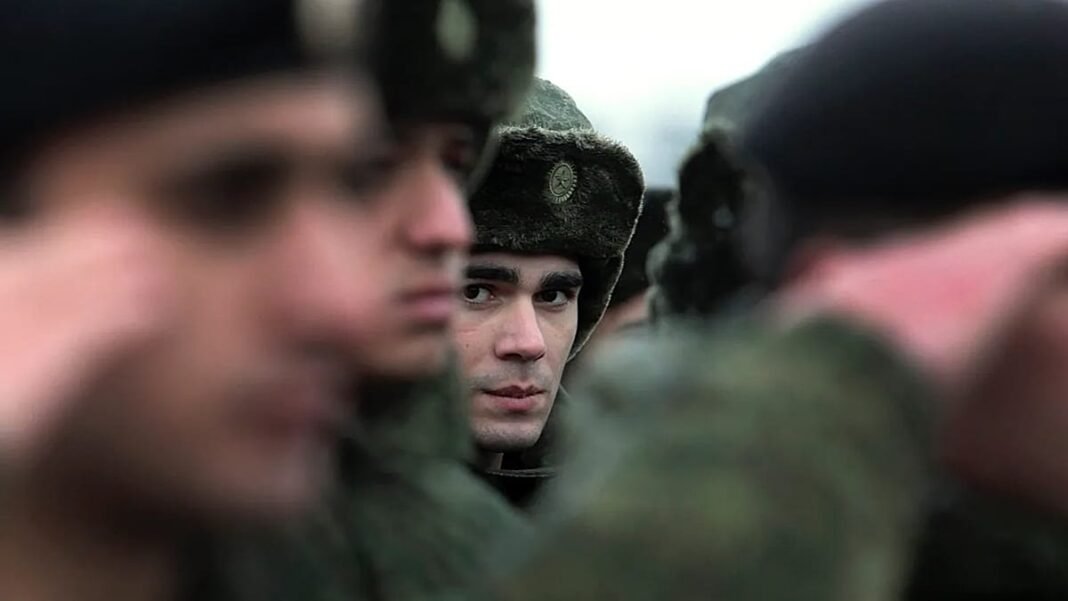
On Tuesday, Russian President Vladimir Putin signed into law a law on year-round conscription into the military, a significant change from Moscow’s traditional two-year conscription cycle.
Before the law reform, young people were drafted into the military twice a year for one year of compulsory military service.
Although conscripts are officially prohibited from being sent abroad, many are offered contracts with the Russian Ministry of Defense, pressured, and then sent to Ukraine. Even without an agreement, conscripts were already being sent to illegally annexed Crimea.
The drafters of the bill say the measure aims to relieve pressure on the military’s conscription bureau and streamline its operations, such as conducting medical examinations and allocating conscripts to various military branches.
They argue that even though the bill makes conscription year-round, it specifies that conscripts serve only during the spring and summer months, as before.
The Russian military calls up between 130,000 and 160,000 conscripts in each round of conscription.
Russia gradually expanded the size of its military
Since the beginning of Moscow’s full-scale invasion of Ukraine, Russia has had a military presence of 1 million people, gradually increasing its size as the fighting drags on.
President Putin last year ordered the number of active-duty soldiers to increase by 180,000 to 1.5 million. He said last month that more than 700,000 soldiers were fighting in Ukraine.
As part of efforts to combat draft evasion, authorities earlier this year launched an electronic draft registration system that allows for online summons in some regions of Russia.
Moscow has also introduced a series of legal restrictions for those who ignore subpoenas, including banning them from banking, suspending their driving licenses and preventing them from traveling abroad.
As Russian troops retreated early in the battle, President Putin ordered a “partial mobilization” of 300,000 reservists in autumn 2022, a widely unpopular move that led to hundreds of thousands of them fleeing the country to avoid being called up.
Putin’s decree had paved the way for more reservists to be called up, but the Kremlin reversed course and focused on reinforcing the force with volunteer soldiers, who offer relatively high wages and other benefits.
Russian authorities reported that about 440,000 volunteers will join in 2024, and another 336,000 signed military contracts this year.
But even as the military seeks to bring in more volunteers, lawmakers on Tuesday approved another bill that provides for the use of reservists to protect “vital facilities” in some areas. The bill’s authors say it aims to strengthen defenses against Ukrainian drones that have reached depths of more than 1,000 kilometers inside Russia.
This measure does not apply to all reservists. Only those who signed contracts to remain on the Active Reserve will be affected.